Description
What are LED strips?
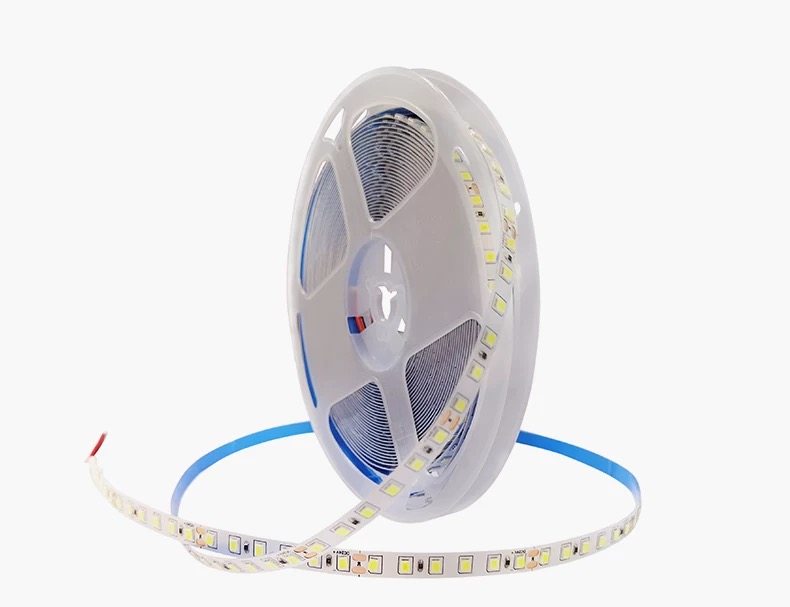
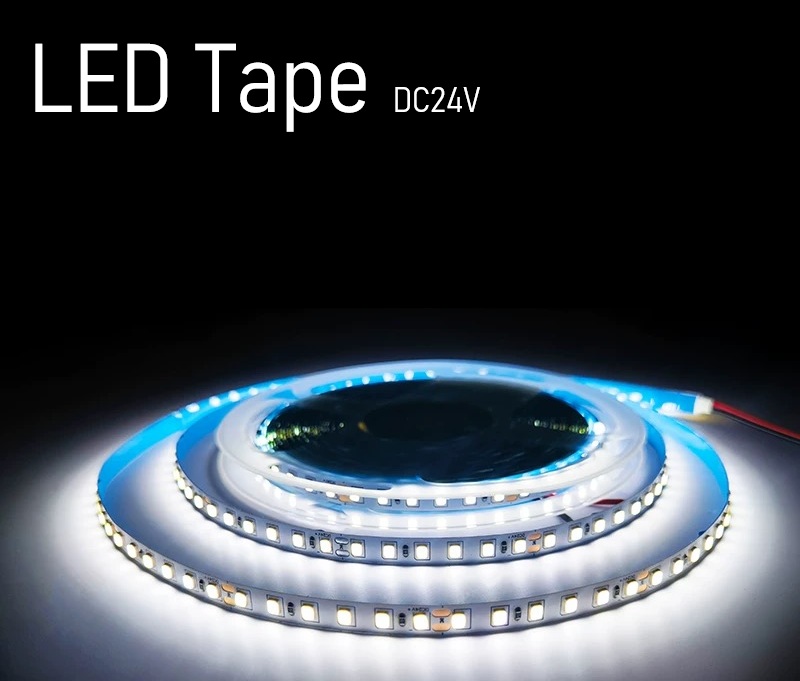
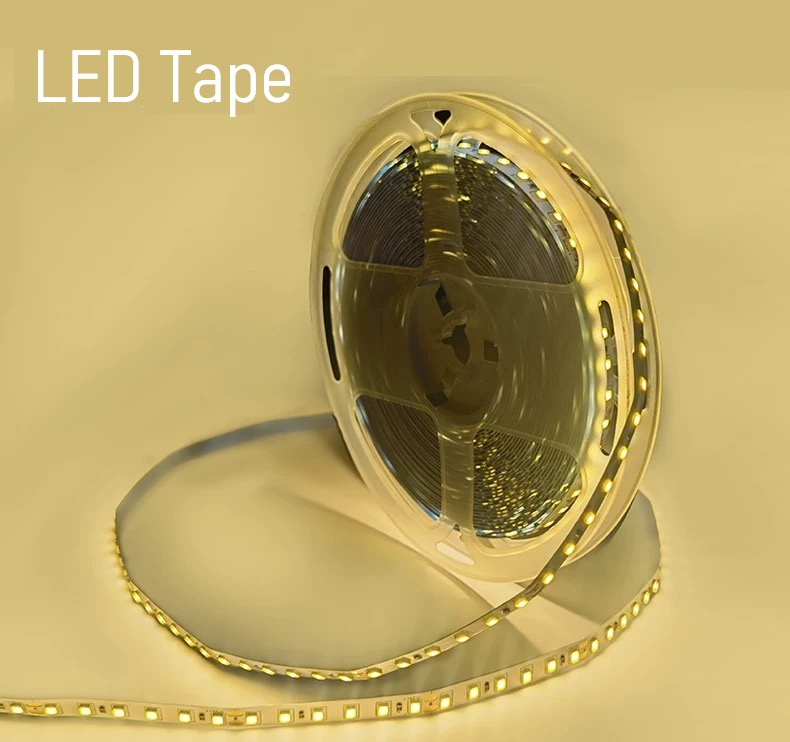
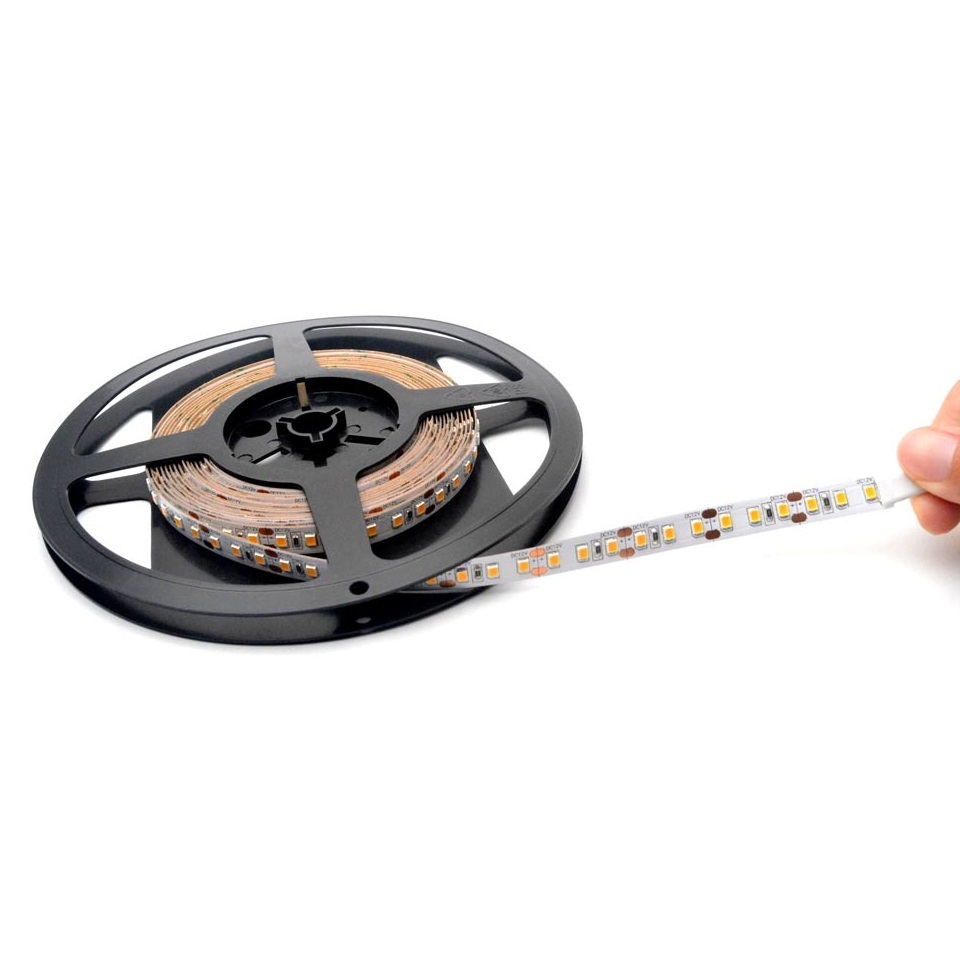
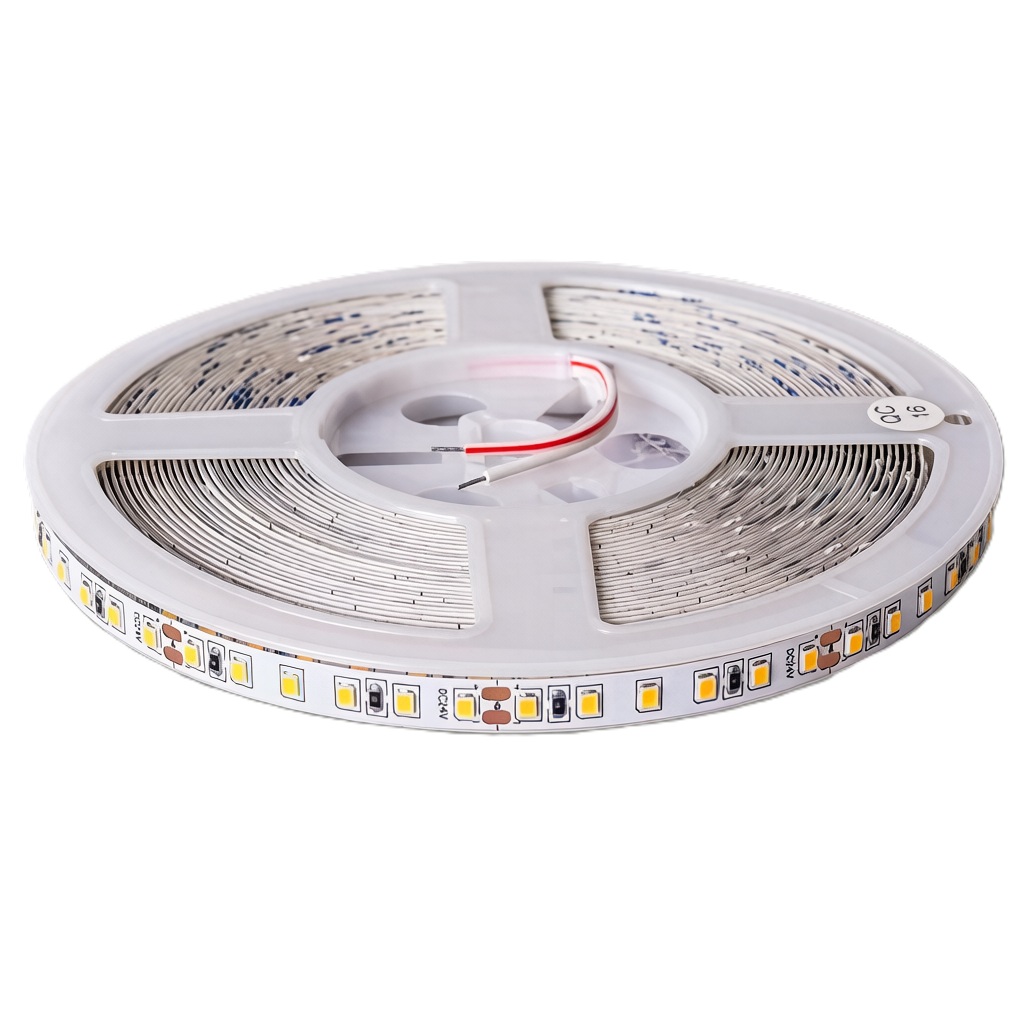
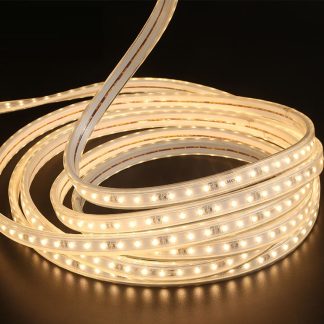
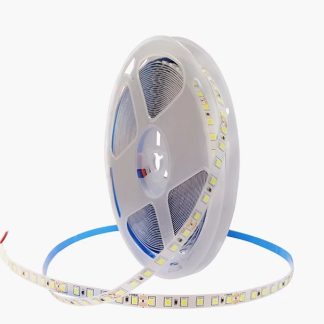
LED strips are a flexible lighting solution which is in fact a long thin circuit board, which can be used for domestic and commercial lighting. Strips come in different widths and typically come rolled up like a tape or ribbon with small lights (LEDs) evenly spaced. LED strips often come with an adhesive backing and can be placed directly onto surfaces such as walls, inside cupboards and flooring.
Why choose LED strips?
Strip lighting has become increasingly popular over the past few years due to their ease of installation, limited maintenance requirements and numerous applications. They provide an effective lighting source, particularly for hard-to-get-to and non-uniform spaces. The variety and customisation which LED strips offer is another reason for their popularity.
The LED strip lights feature ultra-high light quality that truly replicates incandescent and halogen lighting in a versatile and modern LED strip form factor. Flexible and cuttable to length in 50mm increments, these LED strips are an excellent option for high-end residential and hospitality lighting applications.
LED STRIP LIGHTS, EVERYTHING YOU NEED TO KNOW BEFORE YOU BUY
What is an LED Strip Light?
LED strip lights are new and versatile forms of lighting. There are many variants and exceptions, but for the most part, they have the following characteristics:
- Consist of many individual LED emitters mounted on a narrow, flexible circuit board
- Operate on low-voltage DC power
- Are available in a wide range of fixed and variable color and brightness
- Ship in a long reel (typically 16 feet / 5 meters), can be cut to length, and includes double-sided adhesive for mounting
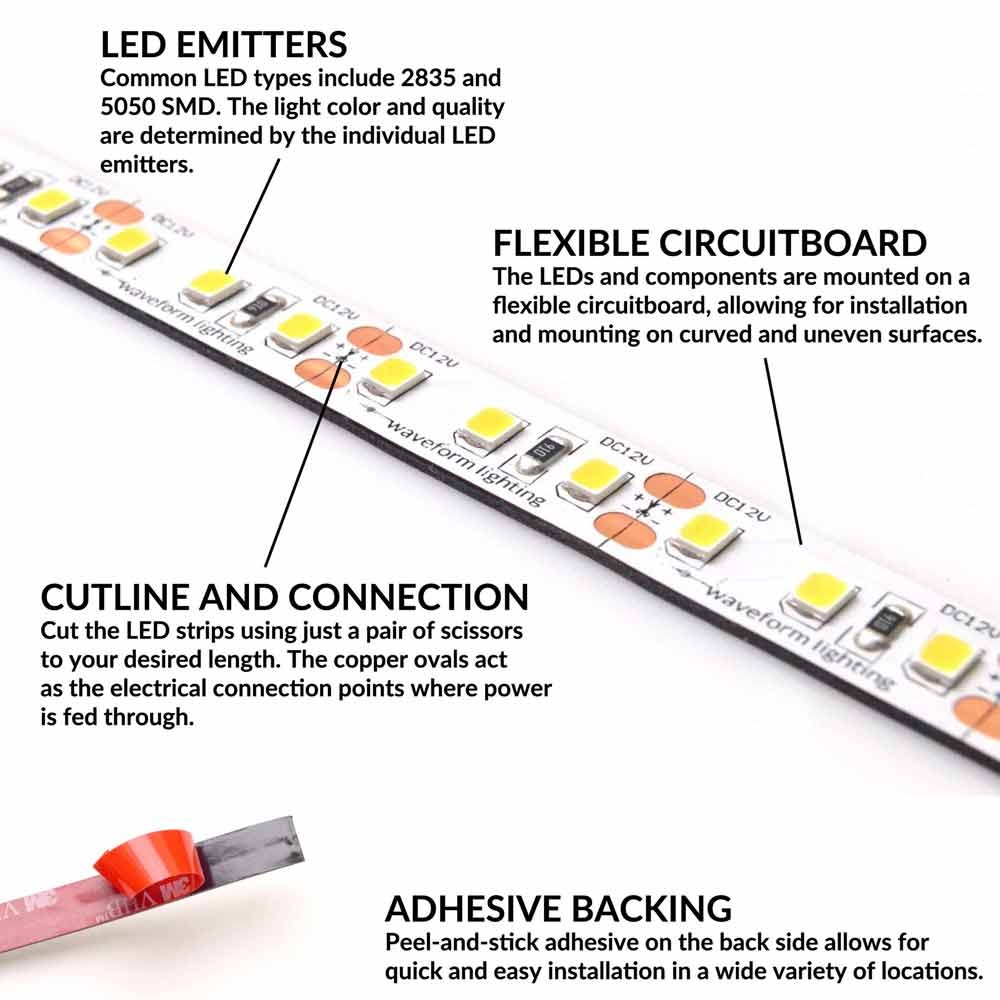
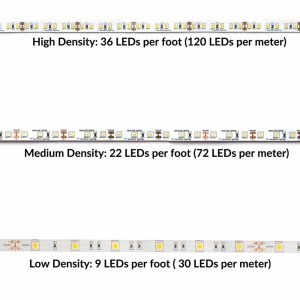
Anatomy of an LED strip, An LED strip light is typically half an inch (10-12 mm) in width, and up to 16 feet (5 meters) or more in length. They can be cut to specific lengths using just a pair of scissors along the cut lines, located every 50mm. Individual LEDs are mounted along the strip, typically at densities of 18-36 LEDs per foot (60-120 per meter). The light color and quality of the individual LEDs determine the overall light color and quality of the LED strip.
The backside of the LED strip includes pre-applied double-sided adhesive. Simply peel off the liner, and mount the LED strip to virtually any surface. Because the circuitboard is designed to be flexible, LED strips can be mounted on curved and uneven surfaces.
Determining LED Strip Brightness
Brightness of LED strips is determined using the metric lumens. Unlike incandescent bulbs, different LED strips can have different levels of efficiency, so a wattage rating is not always meaningful in determining actual light output.
LED strip brightness is typically described in lumens per foot (or meter). A good quality LED strip should provide at least 450 lumens per foot (1500 lumens per meter), which provides approximately the same amount of light output per foot as a traditional T8 fluorescent lamp. (E.g. 4-ft T8 fluorescent = 4-ft of LED strip = 1800 lumens).
LED strip brightness is primarily determined by three factors:
- Light output and efficiency per LED emitter
- The number of LEDs per foot
- The power draw of the LED strip per foot
An LED strip light without a brightness specification in lumens is a red flag. You will also want to watch out for low cost LED strips that claim high brightness, as they may overdrive the LEDs to the point of premature failure.
LED Density & Power Draw
You may come across various LED emitter names such as 2835, 3528, 5050 or 5730. Do not worry too much about this, as what is most important in an LED strip is the number of LEDs per foot, and the power draw per foot.
LED density is important in determining the distance between LEDs (pitch) and whether or not there will be visible hotspots and dark spots between the LED emitters. A higher density of 36 LEDs per foot (120 LEDs per meter) will typically provide the best, most evenly distributed lighting effect. LED emitters are the most expensive component of LED strip manufacturing, so be sure to account for LED density differences when comparing LED strip prices.
Next, consider an LED strip light’s power draw per foot. The power draw tells us the amount of power the system will consume, so this is important to determine your electricity costs and power supply requirements (see below). A good quality LED strip should be capable of providing 4 watts per foot or more (15 W/meter).
Finally, do a quick check to determine if the individual LEDs are being overdriven by dividing the wattage per foot by the LED density per foot. For an LED strip product, it is usually a good sign if the LEDs are not driven at more than 0.2 watts each.
Learn more about the factors that affect LED strip light longevity.
LED Strip Color Options: White
LED strip lights are available in various shades of whites or colors. Generally, white light is the most useful and popular option for indoor lighting applications.
In describing the different shades and qualities of white, color temperature (CCT) and color rendering index (CRI) are two metrics that are important to keep in mind.
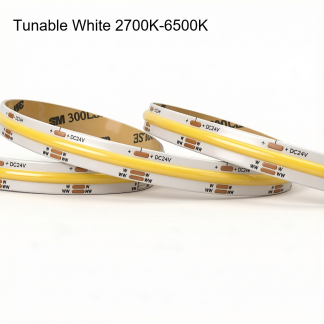
Color temperature is a measure of how “warm” or “cool” the light’s color appears. The soft glow of a traditional incandescent bulb has a low color temperature (2700K), while the crisp, bright white of natural daylight has a high color temperature (6500K).
Color rendering is a measure of how accurate colors appear under the light source. Under a low CRI LED strip, colors might appear distorted, washed out, or indistinguishable. High CRI LED products offer light that allows objects to appear the way they would under an ideal light source such as a halogen lamp, or natural daylight. Also look for a light source’s R9 value, which provides further information about how red colors are rendered.
Determining LED Strip Quality
Sometimes, it can be tricky to distinguish between LED strip lights designed for high performance and longevity, and those that are not. Below are some pointers for knowing where to look.
Circuitboard Composition & Quality – For higher power LED strips, the quality and specification of the underlying circuitboard is paramount. Because high levels of electrical current must travel through each section, sufficient copper material is needed. Look for LED strips with a copper weight of at least 2 oz, and ideally 4 oz to ensure the circuitboard can handle the higher power – otherwise, you can become victim to voltage drop.
LED Quantity & Quality – The efficiency, quality and stability of light output is directly determined by the LED emitters. Look for LED strip lights that place stringent quality controls and specifications on the LED emitters, and watch out for LED strips that claim a high power despite a low LED count, as this can indicate overdriving the LED emitters, leading to premature failure.
LED Strip Surface – High quality LED strips will usually include an extra coating of white paint to help increase the reflectivitiy of the light and increase overall light output. Lower cost LED strip options will use skip this step, keeping the copper color exposed. This can affect both the brightness and color of the light, especially in an aluminum channel installation.
Warm White: Available in 2700K or 3000K with the industry’s highest color rendering, objects will appear warm yet vivid, all the while consuming just a fraction of the energy.
Reviews
There are no reviews yet.